Showing posts with label poetry. Show all posts

Thursday, January 8, 2026

Teaching Poetry - Line Reading with Mary Oliver's "Beside the Waterfall"

I find that poetry can be tricky to teach, for me at least.  Poetry was NOT why I got into teaching English.  Short stories?  Yes.  Novels? Yes.  Grammar and MLA?  Yes and yes.  Poetry is a different story.  

I have spent the last thirty years trying to get better at it (well, maybe not as focus on the task as I should have been for some of the years).  This year I am using Foster's How to Teach Poetry like a Professor to give me a bit more insight on how to teach it to my students.  


You can get it here: https://www.amazon.com/How-Read-Poetry-Like-Professor/dp/006211378X if you are interested.  

One of the first things he mentions is to read the sentences, not the lines.  He posits that "lines are the enemy of meaning."  I think it is a good first step to get students who struggle with poetry to start parsing out understanding.  He uses "I Could Not Stop for Death" by Dickinson as an example, but I think I found a better one to use for teaching this particular concept - Mary Oliver's "Beside the Waterfall".

You can see it better at the Poetry Foundation page: https://www.poetryfoundation.org/poetrymagazine/browse?volume=162&issue=5&page=6 or feel free to grab it off the Google Doc I have of that same image: https://docs.google.com/document/d/16NB7d6AmDUSAWFU3XvAgdgKc_tX3aQD9o0x5JBnEJB0/edit?tab=t.0

Why I like it?  Dickinson certainly has her place I do love that particular poem of hers (plus she is great for a common meter lesson).  The students, though, at least the ones struggling with finding meaning, are wary about all those dashes.  This poem by Oliver does not have that.  It is also a bit more modern than Dickinson, which can be easier to approach as well.

The lines here are meant to look like waterfalls (I think so anyway), but they are in no way dividing up meaning.  This is a perfect example for students to ignore line and stanza breaks to read the poem.  There is all sorts of perspective to get into the meat of the meaning (probably poor choice of words) - on the one hand, the dog eating the fawn seems disturbing, but we end with it just being a dog doing what dogs do.  The dog has a flower-like face as well.  

I will be using this poem today and I think that it will be a great shoe horn for my students struggling and will give them a little more confidence before we go into the next lesson about sounds of poetry.

If you have other strategies for students who struggle with poetry, shoot me an email or leave a comment!  If you don't, feel free to just swing into the comments to say hi.

If you are looking for more poetry help, nothing has helped my students (of all levels) grasp poetry better than this archetype lesson.  

Thursday, December 4, 2025

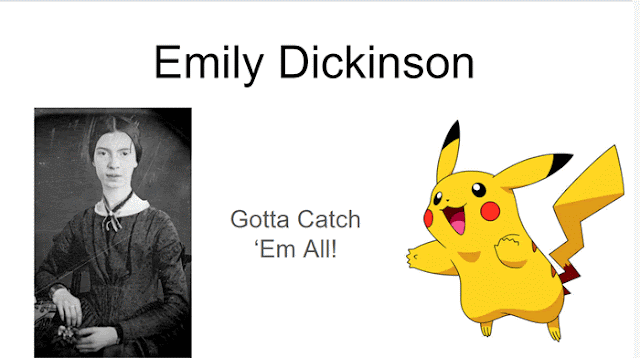
Gotta Catch Them All (Emily Dickinson Poems, of Course!)


As we go toward the end of the year, we may find ourselves with some awkward pacing.  You can't always test on the last day (and that provides some headaches when students are absent and now have to wait until January to be tested on material they have forgotten) and you don't want to start something new just to have a two week interlude.

Here's a lesson that can be in about half a period.  It's fun and it is content relevant.

If I were teaching American Lit, I would just do this when I get to Emily Dickinson.  But as a British Lit teacher and an AP Lit teacher, we still talk about meter, iambic pentameter, and the effect these have on the poetry.  This especially works well after trying to teach a Shakespeare play if you focused any on how iambic pentameter works.

This presentation has students read three Emily Dickinson poems.  Feel free to go into whatever detail about Emily Dickinson's life you would like to add (she had a killer cake recipe and if done her way is coated with brandy and lasts quite a long time!).  Have the kids experience the poetry and get their thoughts.  They are short and different from what many kids are used to, so can be quite fun for discussions.

Then hit them with the common meter lesson.  This will seem boring until they get to the next slide - 


 I've taught this to standard and inclusion kids and they really perk up to this part.  Once you explain to them that all the above poems can be read to this song because of common meter, they are awed.  You are the cool teacher!

Want more cool points as a teacher?  Break out the karaoke machine and have the kids sing the poem into the microphone.

I provided slides to encourage the re-reading of the poems Pokemon-style.  Then we hit them with a few more songs they may be familiar with to wrap it up.  This can take you anywhere between 15 minutes to 30 minutes (maybe more) depending on how conversation goes.

https://docs.google.com/presentation/d/1lFyBrFx8ejMu3_1w4l8SvcPVZ91M8k5SsLpVHY8ENhI/edit#slide=id.p


Have fun with it!  


If you want something to help with your iambic pentameter lessons for Shakespeare, look here!

Thursday, November 14, 2024

Freebie: Poetry with Odd Man Out

I was looking through my notebook where I scrabble out ideas so I won't forget them and I discovered two things of interest.

The first was the words UNSEEN POEM written at the top of the page, but there was nothing else on the entire page, so I guess that poem will remain unseen.  :)   I have no idea why I wrote that in my notebook.  I am sure it was a genius idea that, alas, is gone forever.

The second was this idea for Odd Man Out.  Full disclosure, I don't remember if I thought this up and wrote it down or if I heard the idea from somewhere and wrote it down.  So here is the activity - give the students four poems with three of them being from the same author and one from a different author.  Let them get into groups and analyze the poems and see if they can figure out which poem was written by a different poet.    I figure I will start with this gem from the past:


Then I will give the group the first page of this handout: https://docs.google.com/document/d/1bOSbo7rGxUW7bWnbBzATffoHzAQTN8SPcRnuxr_LSKo/edit?tab=t.0

The first page has three poems from Cavalier poet Sir John Suckling and the poem in the bottom right hand corner is from Cavalier poet Thomas Carew.

I can do it again later or int he same day with the second page which has three sonnets by Elizabeth Barret Browning and one from Christina Rossetti (the one in the upper right hand corner).

Feel free to borrow the handout and try it in your own class.  Even if the kids are wrong, the practice at analyzing the poems will be worth it.

Friday, April 12, 2024

The Masked Poet - Ozymandias


In 1817 and 1818, Rameses II was all the rage and topic of many a conversation.  Around Christmastime of 1817, Percy Shelley and his buddy Horace Smith were sitting around discussing ancient pharaohs, as one is wont to do, and decided to see who could write the best poem about Rameses II using the title "Ozymandias".  Both got published and experienced some acclaim, but Shelley's poem is the one remembered.  

That begs the question - is Shelley's poem remembered because it is greater or because he was the more popular poet?  The power of an author's name is nothing to dismiss.  Look at any Stephen King book published today and you will see his name in large letters and the title of the book small in comparison.  You also have the trend of writers loaning out their characters (Tom Clancy and Clive Cussler do this) and their name is still huge while the actual writer of the book gets the small print at the bottom of the cover.

In order to figure this out, we need a little blind taste test (so to speak) and what better way to do that than in the spirit of The Masked Singer?


I have a document made up and ready to print for your classroom needs.  You can get it here.  One one side, we have The Rook (Percy Shelley) and the other side we have The Bishop (Horace Smith).  I hand it out to students randomly so that they read different sides first since the order of reading may impact the judgement of the two poems.  

If you use it in your class, drop me an email or leave a comment.

Tuesday, January 23, 2024

Metaphors

Looking for a poem to teach, a way to teach literary terms, or just want a  quick lesson to fill a gap?  Look no further than "Metaphors" by Plath.  I'm sure you've read and may have taught it before, but in case you are not familiar with it, here it is:


Metaphors 
by Sylvia Plath

I’m a riddle in nine syllables,
An elephant, a ponderous house,
A melon strolling on two tendrils.
O red fruit, ivory, fine timbers!
This loaf’s big with its yeasty rising.
Money’s new-minted in this fat purse.
I’m a means, a stage, a cow in calf.
I’ve eaten a bag of green apples,
Boarded the train there’s no getting off.


This works really great with a SmartBoard-like projection or even an overhead since marking up the poem as you read it as a class is easier for the students to visualize.

Students tend to be intrigued by it when you build it up as a mystery to be solved.  You can even up the ante by putting something up to win for the first person to figure it out.  With that objective, I do not tell them this is about a pregnancy.

First thing, have students read the poem to themselves and have them write down what they think the poem is about, just so they have an reason to try and process it.

Title - Metaphors are often missed by students because, while it is easy to understand most comparisons, many metaphors leave off what is being compared, like in this case.  We get one of the objects for comparison, but not the whole thing.

Line 1 - Plath wastes no time handing out the clues.  I say to the kids, "This poem is way over nine syllables!  What is this about?"  Eventually some student will figure out that the line is nine syllables long.  Then I have students check the other lines and yep, all are nine syllables exactly.  A clever student might point out that there are nine lines.  A super clever student might point out that there are nine letters in the title.  So we mark on our clue board that nine must be important.

Line 2 - We take the time to figure out what ponderous means.  I usually at this point do not point out that people live in a house.  I wait and let someone pick up on that or we just move further.

Line 3 and 4 - We take the time to look up what "tendrils" means.  Then maybe draw a quick doodle to get a visual.  Students usually focus on these first few lines about she is fat.  We do focus on the tendrils are pale because they must not be getting sunlight.

Line 5 - So they start to put together that whatever she is, she's getting bigger.

Line 6 - Students often have to be told what minted means.

Line 7 - We touch on what it means to be a "means to an end".  My more rural students at this point figure it out since they know what it means for a cow to be in calf. I sometimes skip over this clue to prolong it a bit, if no one points it out.

Line 8 - While apples do come in the green variety, I ask them if we take the idea that apples are typically red, what do you think happens if you eat a bunch of unripe one?

Line 9 - With abortion being in the spotlight, you can choose how close you want to dance on this line that there is no getting off.  However, I do like to talk about getting on a train is an archetype for a major life change/decision (like Polar Express).

If students figure it out early, you may want to see if they notice how her viewpoint of this situation seems to spiral downward as the poem goes on.  At first, she talks about how fat she feels, but by the end, she feels trapped with no way out of the situation.

I often do this with ninth graders, since the idea of being pregnant isn't the first thought that pops into their mind, but I have used this before with other grade levels with much success.


If you are looking for more texts to use in order to teach students inference, try Ordeal by Cheques.