Tuesday, December 15, 2020

Common Lit


Want a pretty easy-to-use, but also effective reading comprehension activity?  You need to look no further than https://www.commonlit.org/

Common Lit has thousands of reading passages with questions ready to go.  Once you set up an account, it is pretty easy for students to use.  You just give them your access code.  You can make a separate code for all of your periods to help keep that grading from getting muddled.

Fiction Passages - Unlike many other online reading comprehension sites out there (I'm looking at you, Newsela), Common Lit has fiction as well as nonfiction.  In fact, they have a lot of fiction - and from well known authors too.  The passages are from classic authors like Frost and from contemporary authors like J. K. Rowling.

The Difficulty Level - You choose how difficult you want this to be.  Passages are labeled by grade level, but the students do not see that.  My seniors are not strong readers and I usually give them passages between 8-9 grade level.  They do not know.  Sometimes I'll go as low as 4th grade and as high as 12th grade.  Whatever level I find useful for the moment.

Passage Length - How long do you want it?  Some passages are poems as short as three lines long.  Some are full length short stories going of for pages.  For my purposes, I usually find ones that are about a half to a full page in length.

Selection - You can sort passages by a variety of filters - Lexile level, grade level, genres, themes, literary devices.  You can even search by the novel you are reading in class and find supplementary texts that pair nicely with the book (they even suggest where you should be in the book before assigning the article).

The Questions - They have some that are multiple choice and some that are short answer.  You can choose to assign both or just the one or the other.  The multiple choice questions are automatically graded while you need to grade the short answer.  Students will not see the grades until you release the scores.  That way you can make sure everyone has had a chance to submit the questions before the correct answers are floating around.  You also have the option to exempt students or assign a passage to a particular student or group.

Here's How I Use It - Each Monday I assign two articles for students to work on that week.  They have until Sunday at midnight to work on them (well, that is what I tell them - it really is until Monday morning when I come into school).  On Monday morning, I go through those assignments and exempt students who haven't attempted it yet (it's an easy two click process).  This makes it so that they students will no longer have access to those articles.  Then, when I have the time, I input their grades into PowerSchool and release the score tot he students.  I also, each week, assign one optional make-up article to replace a bad or missing grade.  With this set up, if I have a sub or need to fill some time, one of my go to lesson plans is to give students time in class to knock out a Common Lit article or two.  

Oh, I may have forgotten to tell you this - IT'S ABSOLUTELY FREE!  Guys, it doesn't LOOK like a free site.  There are no ads.  They could easily - EASILY - charge school a few thousand a year for access to this tool.  But they don't.  They are EXTREME!

I'm interesting in hearing from anyone else who uses it or has another online reading comprehension tool that they use.  tell me in comments!


Thursday, November 19, 2020

Wireless Microphone

 My district is looking at returning to in-person, but we will be teaching a virtual class at the same time.  Teaching virtually ties me down to the laptop since if I move too far away from it, the remote students can't hear me.  Sticking right at the computer diminishes my ability to teach the kids in the room.  So what to do?


I decided to look into a wireless microphone that would work with my computer.  I found this one on Amazon and a video of a guy testing it out.  He was a whole block away and I could hear him perfectly!


Now if you only watched a portion of video, you may have seen him using it, but his mouth not synched up.  Later he said that was because he was using the phone instead of the laptop.  He then recorded off his computer and his voice was synch with his mouth.

The downside?  It runs about $50.  

I'm going to keep looking to see if I can find one a little cheaper, but I'm thinking that $50 might be worth it if it works and gives me some freedom to move around the room.


I'd love to hear from any of you who are teaching both in-class and remote at the same time and hear what your problems are and solutions, if you've thought of them yet.  Or if anyone has used a wireless mic - are they worth it?

Wednesday, October 7, 2020

10 Day Blitz

 Just a quick thought here - many of us are working in some sort of remote or hybrid schedule and it is difficult for the students to sometimes get their head around it.  Even though they are doing (most likely) less work than what you would be assigning if you were in class as normal, they are feeling like it is more work than ever.

We get that.  We see it in our own daily schedule.  Who would have thought teaching remotely would take this much effort?

So I've been doing something to help my students get their head around their work.  I looked at what was still left to do and what was most commonly needed to be made up and I broke it down for them by days of the week.  This way, it doesn't feel so overwhelming.  It went something like this:

Monday - do the first Common Lit article; work on vocabulary.com for 5 minutes

Tuesday - do the second Common Lit article; work on vocabulary.com for 4 minutes; if you did not complete the vocabulary crossword then do that today (link to online crossword)

Wednesday - If you are missing a past Common Lit article, do the make up article; work on vocabulary.com for 3 minutes (test tomorrow); work on Author Revision paper for 10 minutes

Thursday - If you did not do the Edmentum Reading Diagnostic test, do that today; if you are missing the Quizizz for chapter 25, do that today (link); if you did not need to do any of the above, work on you Author Revision Paper for 10 minutes

Friday - If you did not do the Grammar Blast, do it today; work on your Author Revision Paper for 15 minutes (you should be done with the 950 words requirement); I will give a make up vocabulary list 2 test at 12:00 - look in your email for login information; Vocabulary 3 test make up will be given at 12:30.

Saturday - If you are missing the Email Etiquette assignment, know that out today.

Sunday - Take a break!

And so on for ten days worth of work.  

This does a few things:

  • Helps the student who is feeling overwhelmed to get his/her assignments together.  It is much better for them than to just give them a list of missing and upcoming assignments.
  • Model for students how to keep up with assignments, especially those who are looking to go to college in a year or two.
  • Helps the parents to assist their child at home by giving them what to remind their child to do (I send this to the students AND parents).
  • Helps you in case an administrator wants to know what YOU  did to help the student.
I try to get the students to Zoom with me one on one and work out a specific schedule just for him or her.  that's always better than a generic one, but a generic schedule is better than no schedule.

It is a bit more work on your already overloaded shoulders, but in the long run, it is time spent that pays off in several ways.


Friday, August 28, 2020

Friday Film Festival: The Lord of the Flies - Modern Classics Summarized

Overly Sarcastic Productions breaks down literature classics in a rather sharp manner!  Watch their take on Lord of the Flies:


Check out my Lord of the Flies survival game you can play in class (if we ever safely get back to a classroom setting, that is). http://lordalford.com/lotf/lotfframeset.htm

Do you do anything special for Lord of the Flies when you teach it?  Let us know in the comments section!

Thursday, May 28, 2020

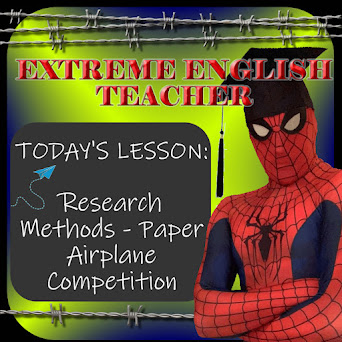
Paper Airplane Research Challenge

Students struggle in English for a variety of reasons.  One of those is learning styles.  Many student I have had are great learners when it comes to working with hands.  Put this kid in a carpentry, auto mechanics, or electrical trades class, and they are showing amazing learning.  Sit this kid in a desk and make him read, well, the learning declines.

Providing opportunities for kinetic learners to shine is not a new concept.  Science sees this in labs and math with manipulatives.  However, this is much more difficult in an English class.

The following activity is designed to help kinetic learners excel at researching by giving them something physical to do with the research.

Extreme English Teacher presents: The Paper Airplane Challenge!


Research methods are what they are.  You teach these methods with any subject.  The paper airplane challenge takes kids through five different research sites to find the best way to fold a paper airplane.  Students will search out and five five ways to fold using five different search methods, then pick one and put it to the test.  After taking kids out of the classroom to compete against each other to find the farthest flying plane, students can also compete for the best and oddest looking.


The lesson comes with directions on how to present the different search methods and a worksheet for students to fill out while searching.


If you like this one, you may also like:
The Movie Report: https://www.teacherspayteachers.com/Product/EET-The-Movie-Report-5452641Ben Franklin Quotes: https://www.teacherspayteachers.com/Product/Extreme-English-Teacher-Ben-Franklin-Quotes-5279912


Thursday, May 21, 2020

Macbeth and Joker - Making Connections

So I watched Joker this weekend, finally, and my English teacher nerd brain immediately thought of Macbeth. 

****Spoiler Alert if you are planning on watching the Joker movie anytime soon***


Joker is an excellent movie to watch - once.  I can't say I would want to watch it again.  I'm sure you have heard that is addresses the issue of mental illness in a way not many movies can encapsulate.

That's an issue for another post (and probably a different blog).  I want to bring in comparisons to Macbeth.  Both are delusional - Joker seeing the woman next to him in his time of need, Macbeth seeing the dagger, the ghost of Banquo, and quite possibly the witches at the end (I always let me students argue if he really does see them in the big apparition scene especially since Lennox comes on stage right where they leave and states that he did not see them - my struggling readers get a kick out of figuring out what is real with Macbeth and not and love to float conspiracy theories).

We can also see how both characters are victims of their own making, even though there were outside forces at work.  Joker certainly has mental illness, a failing government health system, a history of being abused as a child, and just rotten people all around him to push him into action, but when it comes down to it, HE is the one who actually acts.  Same with Macbeth.  Certainly we can lay some blame at the feet of the witches, Lady Macbeth, and even some at Duncan for being such a poor judge of character, but in the end, it is MACBETH that chooses to kill.


But I think the biggest parallel is the type of people they both kill - and the order in which it is done.  let's look at Joker's murders compared to Macbeth's:

Joker:

  • The two guys on the train - self defense - perfectly justifiable
  • The third train guy who was trying to get away - a little less justifiable since the guy no longer posed a threat, but we can see and excuse Arthur (Joker) at this point.
  • His  mother - certainly past excusing, but we can see where he is a victim of his illness here.
  • Randall - now we see Joker going down a road toward senseless murder.  Randall did him wrong, but that seems to be an excuse to murder him at this point.  Arthur still has some sense of himself, though, when he lets Gary leave.
  • Maury - similar to above, but less so since the guy is now giving Joker a chance to succeed at being a comedian, Arthur's goal.  Unfortunately, from this point on, I think we can safely say that Arthur is no longer a character.  Only Joker.
  • The health care worker at the end - here there is no reason to kill her.  She is only trying to help and this murder is irredeemable.  
Macbeth:
  • Macdonwald - brutal killing, but an act done in war and in defense of his king and country.  Perfectly acceptable and even lauded as an act of a hero
  • Duncan - inexcusable, but there is a reason for this murder - Macbeth wants something  and this is the way to get it in his mind.
  • The Guards - logical under the circumstances.  If Macbeth is going to get away with his former act, this is what needs to be done to prevent them from telling others that Lady Macbeth was the one who got them drunk.
  • Banquo - Macbeth has a reason, but we are getting further away from it being a logical reason.  Here we see Macbeth is beginning to become obsessed with killing.
  • Lady Macduff and Little Boy Macduff - here Macbeth crosses the Rubicon.  Up to this point, he at least had a reason to kill, albeit often a flimsy one, but a reason nonetheless.  This killing, though, is not only useless, but only gives Macduff MORE reason to come after him.  
Both go through a progression where the murders get further and further away until we can no longer hope for the protagonist's redemption.  Both of these stories puts the audience in the camp of the villain.  We want to root for Arthur and Macbeth.  It's the nature of the protagonist to have the reader/viewer on his side.  But both stories takes us down a path with the lead character until we feel in a traitorous situation by no longer agreeing with his actions and wanting him stopped.


If you have any good book to pop culture pairings, list them in the comments.

Thursday, May 7, 2020

Daily Reading Comprehension Questions

In my state, we have two English tests that are practically the same.  One is the North Carolina Final Exam (formerly called the MSL, formerly called the Common Exam) for freshmen, juniors, and seniors.  The other is the End of Course for sophomores.

They are quite horrid tests, as I am sure you can relate to in whatever state you are in.  It is more of a test of a student's ability to stay focused for two to three hours rather than an accurate measure of a student's reading comprehension.

I have two daily reading comprehension blogs for you.  While one is labeled for the NCFE and the other for the EOC, they have the same type of questions and will fit most any reading comprehension tests.

The first is the Daily Dose of NCFE:


And the second is the Daily Dose of EOC:


They hit literary terms, vocabulary, author's purpose, inference, and basic plot understanding. 

Currently, they each run for a semester and then recycle the questions. Next year they may be merged into one blog, since supposedly my state is doing away with the NCFE, which should mean I can pick from the best questions on both.

I have had great success on my state reading comprehension test scores.  I've spent a lot of time understanding these beasts.  I do have a free resource on my Teacher-Pay-Teachers store that helps you walk students through prepping for the test.  I usually use it a week before the test.  It gives students a way to stay focused longer during the test.  I know  you probably do not have a state test for your students this year with all the shut downs, but feel free to download and give it a look for next year.  And if you like it, please leave a review for it. It helps me out a lot as a fledgling store owner.

https://www.teacherspayteachers.com/Product/Extreme-English-Teacher-Acing-State-Reading-Comprehension-Tests-5283540