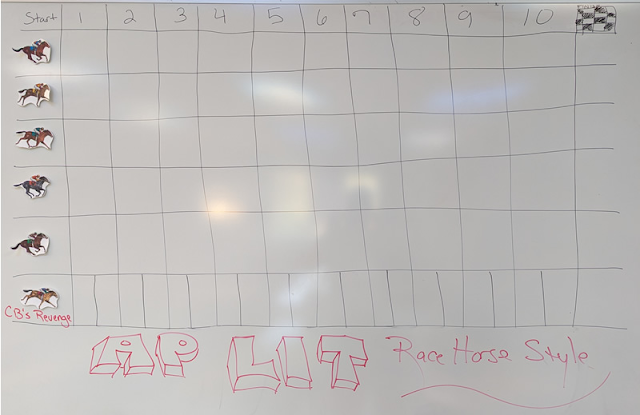
I borrowed this idea from someone else, but for the life of me, I do not know who created the idea. Here's the the unsung extreme teacher out there!
This assignment was done in my AP Lit class, but it works just as well in any class that works with multiple choice reading passage questions (AP Lang, English classes with standardized state tests, SAT/ACT prep, etc.)
Students picked names for their horses and we were off to the races!
TLDR Rules: Students are put into groups and work together to get multiple choice questions correct. Each correct answer moves their horse up a slot. Each wrong answer moves the teacher's horse up a slot (limit three slots per question). First to arrive at the finish line gets prizes.
More details are provided on the presentation slides I set up. You are welcomed to copy it for yourself - no charge!
For a little fun this Halloween, try giving your kids this Kahoot! I made based on the book Frankenstein.
They do not have to have read the book - in fact, it is designed specifically for students who have not read the book. The clever students will soon realize that much of what they know about popular culture Frankenstein's monster has little to do with the monster in the novel.
If you have not seen the movie Nightmare Before Christmas by Tim Burton, you really should. It is excellent for middle school age children and older. As far as class goes, there is a particular song in it that is useful for instruction: "Jack's Lament."
A quick bit of background information for those who have never seen the movie. Jack Skellington (pictured to the left) is the Pumpkin King of Halloween Town (every holiday has their own town). He has just had another successful Halloween. He has, once again, won all the praise of the inhabitants of Halloween Town. And he is bored out of his mind. This is the song he sings to express how unhappy he is, even though everything is going great.
Why show this song clip in your class? To teach allusion. There are several examples and depending on the level of student that you have, they should be able to pick out most.
Here they are in order as they appear in the song:
Sally, the rag golem is an allusion to Frankenstein's monster. Students might be able to figure that out from the stitch marks.
He is walking through a pet cemetery (Stephen King's Pet Cemetery).
Zero the ghost dog - easy Rudolf allusion
There is a grave stone figure that looks like Mushu from Mulan. If students make that connection, that's great. However, The Nightmare Before Christmas came out in 1993 and Mulan came out in 1998, so no true allusion there (though perhaps it inspired the look of the dragon?).
The horse head tombstone is actually an allusion/pun. It looks like the chess piece knight. Use the homophone reference for night.
You have two versions of the Scream painting by Edvard Muench. One tombstone looks similar to the painting and the other looks similar to the Halloween mask designed after the painting. To really drive it home, he even says that he, "grows so weary of the sound of screams," at the same time that he drapes his arm around one of the tombstones. Students might recognize the tombstone from the movie Scream, which has a mask based on the same painting.
He calls himself Jack, the Pumpkin King. Maybe an allusion or at least a play on the idea of a Jack o' lantern?
As Jack stands in front of the moon, it is a reference back to Tim Burton's Batman, when the batwing flies in front of the moon for a special visual effect.
And of course, the Hamlet allusion as he takes off his skull and holds it to recite "Shakespearean quotations."
O.K., did I miss any? I feel like I did. If you notice any more, please leave a comment so that I can add it to the list. I'll give you full credit!
If you have the movie, you'll find this song starting at about 6:10 and ending at 9:45. If you don't, here is a You Tube version:
You can find the lyrics here if you would like to do a lesson on assonance. Every second and fourth line of each stanza uses assonance to fake the rhyme.
In Shakespeare's Macbeth, Macbeth hires two murderers to kill Banquo; however, three murderers show up to the scene. The original two even make a note of it by asking this third interloper who sent him? The answer that he was sent by Macbeth himself has a few flaws.
It would seem that Shakespeare meant to do something with this third guy, but never got around to fleshing it out, leaving English teacher geeks around the globe speculating here and there. This third murderer recognizes Banquo, understands his habits around Macbeth's stables, and was able to give at least some of the original plan to the other two murderers so that they would accept him. Yet he doesn't seem to know all of the plan since he was unaware of the light going out, and as a result, the main target got away.
You can find some more awesome images from Macbeth (including some really freaky looking witches) by going to the artist's (Amy Hood) web site.
So in my class of regular level students, I use this as an opportunity to get them to think deeper. They find the clues and facts, list off everyone who could have been the murderer, and then find evidence to support their favorite suspect. We get into a discussion over what the third murderer's motive was - to help kill Banquo and Fleance or to help Banquo and/or Fleance get away.
I tell them that on their test, they are going to have to accuse one character and then defend their statement. We joked this year about people putting down Banquo as the murderer - a major feat since he was the one being killed at the time.
One student took this as a challenge and on the test stapled an extra sheet so that he would have enough space to properly accuse Banquo for being the third murderer of Banquo. Here is his answer:
Banquo. Banquo fakes his death in a simple process. He knew from the witches that his child would be king and not Macbeth's children. He knew that Macbeth was willing to kill to be king. When Macbeth became king, Banquo knew it was only a matter of time before Macbeth would kill him. Banquo then got body doubles of himself and his son and sent his son out of Scotland. When he heard of suspicious people meeting with the king, he knew it was time, and trailed the two murderers. He declared his double to be himself so that the others wouldn't think otherwise. When his son's double got away and met with Banquo for payment, Banquo killed him to tie up loose ends. I believe that after the play ended, Banquo got his son to take over Scotland and then ruled through the shadows.
Flawed? Sure, but he was so excited to prove that I was wrong when I said that Banquo COULDN'T be the third murderer. It's not often that you get a regular level student to get this passionate about a test answer.
This same kid followed up this response with the answer to this question: Who is most at fault for what has happened in this play?
King James I. Shakespeare wrote this play because of the big stink James made about a supposed "witch" visiting him. If he had stayed calm and not made a big deal out of it, this play would never have been written.
Folks, it's hard to argue with this kind of logic. :)
The following lesson takes a 90 minute class to teach depending on the discussion you and your kids put forth. You can, of course, break it up as you see fit.
We started the class by reading Shirley Jackson's "Charles". If you've never read it, you find a copy here. It's a good break from the stories involving tragedy or death. I like to have the kids read it in parts (narrator 1, narrator 2, Laurie, Mother, Father, Teacher) since we typically do a lot of individual reading activities.
The story itself is short and fun and is a good way to teach situational irony and foreshadowing. After we discuss these terms and we look at the clues we were given that give away the surprise ending (this is a good chance for those who figured it early to look smart by pointing out what it was that led them to see the truth). At this point, many of the students are wandering how they missed it on the first reading. That's when we tackle how Jackson pulls this off - with narration.
The mother is out narrator here and her view of her son contradicts elements in the story, but, being a mom, she gladly puts the blinders on and sees the best of her child and quickly dismisses any character flaws as being the result of this Charles kid. Since she so willingly buys into it and since we have no reason to believe she is an unreliable narrator (and even more so since she does not believe herself to be one), we easily buy into her worldview. Since she believes her child whole heartedly, we are forgiven if we miss that this kids is an intentionally unreliable narrator when retelling the events of each day to his parents. Sure we have situational irony and foreshadowing, by the master writer here uses narration to deliver both of these in this story.
Now that they have an appreciation for Jackson, we jump in on her more famous work - "The Lottery". At this point the students have some knowledge of our author, so may be looking for the ironic twist and try to figure it out. I give them no warning about the story (other than it is a story that could have gotten me fired on my first year of teaching, but that is a story for a different blog post perhaps). Since I want to do all of this in a day, I go with the old movie version (takes about 18 minutes):
The first round of discussion goes to what the point of the story is and it is rare that we get a student who off the bat realizes that this is about questioning why we do things. If you want to hint to your students to help them find the answer, it lies in anything Old Man Warner (my hero) says. After there has been some discussion on that front, we talk about the background here. It was written in 1948, so people were not as open to change then as we are now. That started with the '60s and progressed with the changing technology, but even now students can relate to groups that do not wish to let go of traditions they hold dear. We talk about all the negative letters it got after being printed in the New Yorker and some of the disturbing reactions (people wanting to know where this took place so that they could go watch it).
Once that is out of the way, we go for how she did it. What technique is present here. The answer, for me at least, is tone. The first half of this movie has a lighthearted tone. everyone is joking and catching up, the kids are playing, no worries in the world. Once Old Man Warner speaks (my hero!), the tone gets more serious and increasingly gets more serious making any joke or light hearted statement seem more and more out of place. Even though we were looking for the ironic twist, we are so thrown off by this shift in tone that it amplifies the results.
After this discussion, we move to a book she is known for - The Haunting of Hill House. Since this is a one day lesson, we don't have time to jump into the novel, but I do reel them in with this clip from the Netflix series by the same name (I know the two are very different in may ways, but the series does try to bring in the psychological horror like the book does - the ghosts react to the personal trauma the people bring to the house). It's not too scary and no jump scares.
By the way, earlier in this episode, the boy found a hat in the house and brought it to his room, which you can see in this clip in the shadows.
Now that the students are looking for how the scene is developed, I usually have someone point out that the tension in this scene is the pacing. The scene moves so slow and it is this that really drives the students to hold their breath like the boy in the clip.
It is almost time for the bell to ring, so we wrap it up by reminding how narration impacts the story in "Charles", tone impacts the story in "The Lottery", and pacing impacts the story in The Haunting of Hill House and they are given a challenge to start looking at how the authors achieve their greatness, not just what is the greatness achieved.
Checking for reading is always tricky. You want to reward those who read and at the same time, you don't want to punish the kid who struggles to remember what they read. My typical fall back for lower level classes is the open note quiz. That way they can use their notes (if they bothered to take any) to help them recall what they read.
However, I saw the other day on a Facebook group someone sharing an alternative that they like to use that I found quite clever. The teacher's name is Katie Jo and this is all her idea, not mine, though I wish it was!
The Spark Note Check
Give the students a copy of the Spark Notes summary of the chapters that were assigned. Ask students to fill in a detail or two (or I guess however many you wish to assign) that the summary missed. She says that she changes up the summary source so that students don't just use Cliff Notes or something else to get around the Spark Notes short comings. She also said that the only downfall she's encountered is that it takes longer to grade than a traditional quiz.
I love it and can't wait to try it. If you have an alternative way to check for reading, please post in the comments!